
Understanding Billion Dollar Systems (The internal structures of unicorns)
Learn how to build the quiet machinery that turns lucky ideas into lasting empires.


People say “we have systems.” Most don’t. They have rituals, hero moments, and founder glue which feel like systems until the founder sleeps, takes a vacation, dies or a key customer goes sideways. It’s even more evident when they to scale revenue, they start having internal problems then wonder why traction melts with scale.
TL;DR
Unicorns aren’t magic, they’re machines. Not flashy ones, boring, repeatable systems: one accountable human, a short process, and a single signal you can read at 3 a.m that produce the same outcome without the founder’s elbow grease. This issue explains what systems really are, why most startups think they have them but don’t, how systems must evolve as you scale because the systems you need at $1M ARR are different from those at $100M ARR and different again on the way to a unicorn. Know the difference, watch for the real signals, build the launch pad and the landing pad and the Systems you need to build next.
What a “System” actually is
When Stripe shipped its first API docs, it wasn’t a marketing stunt. It was a design choice: make the first integration impossible to fail. That one thing, “docs that got a developer to a working payment in 10 minutes” was a system: a single owner (the engineering lead), a tiny repeatable process (copy, paste, test), and a simple signal (“did the test payment go through?”).
That system did two quiet, enormous things. First, it turned strangers into users with almost no hand-holding. Second, it created a feedback loop they could learn from and harden. Over time Stripe hardened compliance, fraud tooling, global rails, but none of that works without that original system that made onboarding trivial.
A system is not a folder in Notion. It’s not “we kind of do this.” A system survives you. If the founder sleeps, the system still runs.
Why most founders think they have Systems and why they are wrong
Early-stage hustle looks like systems. You answer the same emails, you personally fix onboarding for the 7th customer, you run the demo that convinces investors and call it “process.” It feels systematic because you, the founder, are reliable. When you’re the machine, you mistake your presence for structure.
That’s the trap. Real systems survive your absence. Miss a founder email and the system still runs. Miss a meeting and nothing grinds to a halt. If the company pauses when you step out for a weekend, you have process theater, not an operating system.
Three things that fake systems:
Founder glue: the founder handles edge cases and becomes the system. Take a weekend off and watch the flow stop.
Paper processes: beautifully written docs nobody follows because they were never stress-tested.
Premature automation: bots doing tasks that still require human judgment, which hides the real problems instead of fixing them.
You’ll hear advice to “document everything.” That’s fine, until documents collect dust in a Notion corner. Systems are not documents alone. They’re the human decisions baked into steps and the signals that expose false confidence.
Real systems reduce variance. They remove guesswork. They make the company legible to customers, employees, and investors.
How systems evolve as you scale (the 3 landscapes)
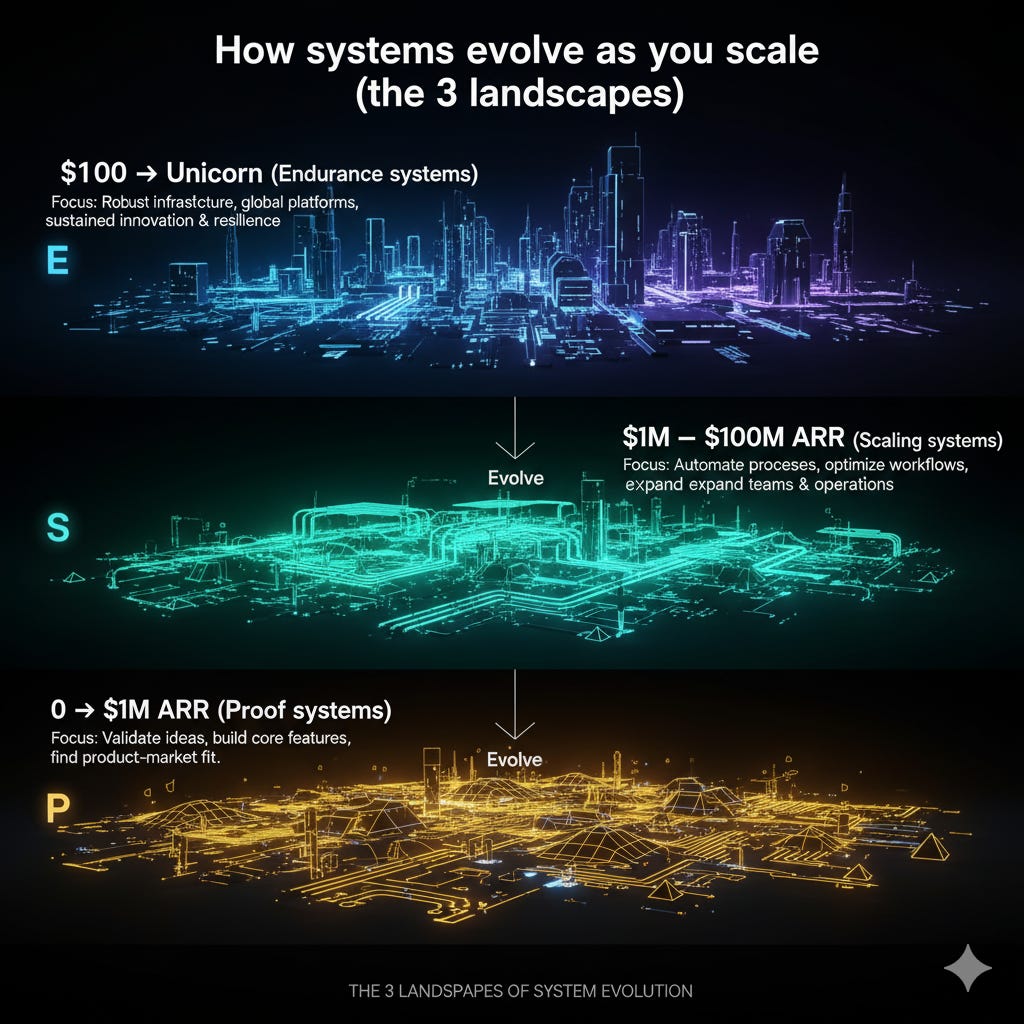
0 → $1M ARR (Proof systems)
You’re proving the product works for real customers. Systems should be human-first and learning-focused. Keep them flexible. The point is to find the unit, the repeatable action that creates value (one demo, one pilot, one onboarding). The right system here is a human playbook, A founder or operator runs it personally, learns fast, and iterates. This is where nuance lives. Don’t automate; learn.
What success looks like: founder touch is deliberate (not default); you can teach the process to one operator without losing signal.
$1M → $100M ARR (Scaling systems)
Volume arrives. Heroics break. Systems must reduce variance and cost, you swap founder touch for SLAs, single owners, and acceptance criteria. You move from “who knows” to “who owns.” SLAs, a named owner, scripted handoffs, and minimal automation. The goal is predictability, you want the same outcome at 10x the scale but cheaper and with fewer surprises. These systems are about removing single points of failure.
What success looks like: the process runs without founder intervention; conversion and time-to-value tighten rather than wobble.
$100M → Unicorn (Endurance systems)
Now scale is a systems engineering problem: redundancy, governance, partner ecosystems, legal frameworks, observability that doesn’t lie. Your systems must be resilient to region failure, regulatory shocks, and rapid product expansion. You’re buying optionality: more markets, more products, same reliability. This is systems engineering for business continuity, it’s not sexy, but necessary.
What success looks like: incidents don’t cascade into churn; new markets plug into the machine without founder-led firefights.
Each stage demands different design choices. Treat your existing system as temporary infrastructure, not permanent wiring.
From manual to productized “Airbnb’s lesson”
Airbnb’s early system was manual: founders photographed listings, coached hosts, and fixed the tiny things that made a listing book. That hands-on work taught them the edge cases. Then they productized those learnings as trust signals — reviews, guarantees, dispute workflows. The manual system taught them the rules; the productized system scaled them.
Your job early is the manual work that surfaces the rules. Your job later is turning those rules into product so the next thousand hosts don’t need a founder on the line.
The launch pad / landing pad distinction
You’ll hear a lot about “launching” channels, growth hacks, virality. That’s the launch pad: the systems that get you airborne. Pilot playbooks, repeatable ad funnels, partner hooks etc. These create lift.
But no one talks enough about the landing pad: the set of systems that let you arrive and continue functioning. SLAs, delivery ops, compliance, escalations, partner SLAs etc. These prevent graceful lift-off from turning into a spectacular crash.
Great founders design both. They don’t just get lift; they prepare to land without breaking everything.
Build a badass launch pad and forget the landing pad, and you get a spectacular crash.
Build both, and the company survives lift-off and becomes repeatable.
Shopify’s launch pad and landing pad in harmony
Shopify made launching a store stupid-easy. That was their launch pad. But they also built partner programs, fulfillment integrations, payments, and merchant success playbooks their landing pad. Launch + land = compounding growth. Without the second, the first is an expensive parade.
When you read Shopify’s history, the lesson isn’t “be everywhere.” It’s “make the first step trivial, then make the next thousand steps managed and smooth.” That’s how a launch pad becomes a runway.
How to decide which system to build next
Stop brainstorming “nice-to-haves.” Use two ruthless questions:
Will this reduce founder time on a critical flow by >30%? If the answer is no, it’s probably not structural.
Will this improve a real customer outcome (activation, conversion, retention) by >10%? If the answer is no, it’s probably vanity.
If the answer is no to either, it’s probably vanity, but if a system meets both, it’s worth the time. Also align with your route: PLG teams prioritize activation systems; enterprise teams prioritize pilot→monetize + delivery; marketplaces prioritize dual-sided intake and fulfillment.
Watch these hard signals, not feelings: founder-touch %, time-to-outcome median, rework rate, incident→churn linkage, cost-per-unit trend. Those are the real pulse checks.
What good systems feel like
They are boring until they aren’t. You’ll feel relieved when someone executes without asking. You’ll feel lighter when a customer complaint is resolved without your inbox heating up. You’ll feel quietly proud when a new hire asks for the playbook and you hand it over.
You’ll also feel the discipline: you will cut good ideas mercilessly because systems demand focus. That discipline looks dull; it behaves like survival.
Final
Please don’t ask me for a template, do this instead:
Write one sentence in your team channel that names the process that wastes the most founder time this week. Post it publicly in your team channel.
That act “visible, blunt, tracking accountability” is the beginning of a real system.
Make one person accountable. If you want, paste the sentence in a reply to this issue. I’ll pick three and send back a single blunt, copyable change you can make on Monday.
Systems aren’t glamorous. They are the quiet currency of survival. Spend them wisely.
So what’s next?
We’ve talked about the machinery behind Unicorns, the systems that make scaling sustainable and the discipline it takes to build both a launch pad and a landing pad.
Next up → Edition 4: The Single Unit of Scale.
We’ll break down the heartbeat of every scalable startup “The atomic unit of growth”.
You’ll learn:
How to identify the one unit that actually drives your company’s scale
Why optimizing anything else first is wasted motion
And how world-class founders protect that atomic unit like it’s oxygen
P.S. Before you scale, find your unit. Then build everything else around it.
— M.O.G